Anúncios
Keeping a clear record of what appears at your feeders turns casual enjoyment into useful science.
Programs like the Ontario Bird Feeder Survey, started by Erica Dunn in 1976, laid the groundwork for Project FeederWatch in 1986 when the Cornell Lab of Ornithology and Long Point Bird Observatory expanded the effort.
When participants submit observations, they add to a multi-decade dataset that reveals shifts in species counts and migration patterns.
Reviewing your own notes helps you spot local changes that mirror larger trends, such as shifts in abundance during unusual weather or habitat change.
Use a simple structure for entries: date, location, species, number, and a short note on conditions. This makes your personal data more useful for research and for community checklists.
Anúncios
Small, steady effort at the feeder can build a reliable record that connects your home observations to broader environmental insights.
Why You Should Track Bird Visits Over Time Journal Entries
Writing down what you see at your feeders stops moments from slipping away and builds useful data you can use later.
Author Rick Chapo stresses that notes preserve memories that daily life can erase.
Anúncios
“Keeping a written log is the best way to prevent your experiences from fading into the background of daily life.”
A tidy set of short entries turns casual sightings and observation into meaningful information for you and for research.
- Document behavior at your home feeders to build a personal data set that shows seasonal change across years.
- Use simple fields—date, location, species, number, notes—to make each entry useful to others.
- Choose paper or digital formats; consistent notes improve identification and support community checklists.
- Immediate entries keep weather and exact conditions accurate and vivid for future reference.
In short, regular entries bridge casual nature moments and formal research. They inspire future birding adventures and make your observations part of a larger story.
Essential Tools for Your Backyard Birding Records
Choosing the right supplies helps you capture clear, consistent records from your backyard view.
Choosing the Right Format
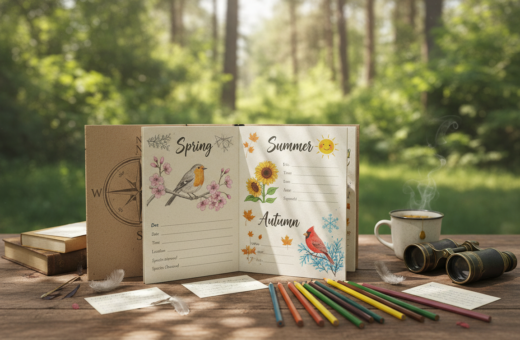
Pick a format that fits your routine. A compact paper notebook or a mobile app both work well.
Paper is tactile and simple. Digital apps can speed data entry and sync with a website for research.
Protecting Your Notes
Keep entries safe from rain and spills. Use a weather-resistant notebook or a clipboard with a cover. Store your journal in one place near your main feeder so you are ready to record every entry.
- Project FeederWatch shows that proper tools help 25,000+ participants collect consistent data.
- Look for cue fields for weather, location, and number to capture key details about species and habitat.
- The Cornell Lab website offers guidance to structure observations and improve data quality.
How to Structure Your Observations for Long Term Success
A consistent observation format turns casual notes into datasets researchers can trust. Use a simple structure and stick with it for each entry. This practice makes your data comparable and useful.
Follow the FeederWatch protocol by recording the maximum number of each species seen simultaneously during a 2-day checklist period. This prevents double counting and keeps your counts reliable.
Standardize core fields: date, location, weather, and number. Add a short notes line for behavior or unusual conditions. These elements let others infer zeros and presence-absence from your records.
- Consistency: use the same entry layout every checklist.
- Clarity: record the maximum number seen at once.
- Context: include weather and site information.
- Flexibility: let your structure evolve to capture more nuanced data as you gain experience.
Whether you prefer paper forms or digital tools, a repeatable structure turns casual nature notes into high-quality data. Participants who follow this approach help researchers study larger ecological patterns.
Key Data Fields to Include in Your Birding Journal
Context makes raw numbers meaningful: note snow cover, temperature, and feeder setup with each entry.
Recording Environmental Context
Record date, location, and simple weather cues. FeederWatch participants use categorical estimates for snow cover and conditions. These fields explain why activity changes from day to day.
Documenting Bird Behavior
Write short notes about feeding and interactions. Observations of how species behave at the feeder add depth beyond counts.
- List the number of each species seen during the observation period.
- Note feeding habits, aggression, or flocking behavior.
- Include any unusual occurrences that might affect patterns.
Sketching for Identification
Quick sketches force you to see plumage, bill shape, and posture. These details help confirm IDs later and improve your data quality.
Tip: Treat your notebook as a living document. Record date and time with each entry and add a short line about habitat or cover. Over years, these consistent fields make your contributions useful to researchers and the community.
Maintaining Accuracy in Your Backyard Sightings
Simple validation steps cut down on mistakes and reduce the chance an observation needs review. Before you submit a checklist, pause to confirm counts and spelling. Small fixes stop many automation flags.
Understanding the Flagging System
Project FeederWatch uses automated filters that flag counts more than three standard deviations from the mean for a given species and region. That system prompted reviews for just 1.52% of 34,074,558 submissions between 1988 and 2020.
Only 48,417 entries—about 0.14%—were permanently flagged after expert review due to insufficient evidence. Expert reviewers use species biology and local habits to validate unusual records.
- Double-check entries: confirm the number and fields on your checklist before sending.
- Document context: note habitat and snow cover to support rare observations.
- Correct in real time: quick edits catch typos and reduce manual review.
Consistent, accurate data helps participants contribute to solid scientific results. For more tips on making high-quality entries, see this helpful submission guide.
Using Your Journal to Track Bird Visits Over Time
A steady set of notes turns casual backyard sightings into a useful local dataset. Keep entries simple: date, location, species, and number. Short notes on behavior or weather add context.
Project FeederWatch data suits occupancy modeling because it uses repeated observations from the same location across many years. You can use their website to pull historical outputs and compare your current checklist to past checklists.
Comparing numbers of each species across years helps reveal shifting patterns in migration and local abundance. That side-by-side view shows arrival and departure trends you might miss in a single season.
- Be consistent: update your record regularly during the season.
- Compare counts: note the number for each species across years to spot patterns.
- Use tools: the FeederWatch website helps visualize your data and long-term trends.
- Keep sketches: quick drawings and short notes preserve the personal view of your adventures.
Over years, a well-kept journal becomes both a scientific resource and a personal archive. It links your observations and data to larger studies while preserving the joy of each sighting.
Common Mistakes That Can Skew Your Birding Data
Simple habits—how you count, when you write, and what you note—shape the usefulness of your observations.
Overcounting Individual Birds
Overcounting is common when the same individual moves among feeders. Follow the FeederWatch rule: record the maximum number seen at one time on each checklist.
That approach prevents double counts and keeps your number entries comparable across dates and locations.
Inconsistent Reporting Habits
Skipping sessions or only recording when you have spare time creates gaps in the dataset. These gaps make it hard to tell if changes reflect real species shifts or just changes in effort.
Also note feeder changes, feeding schedule adjustments, and misidentifications. Short notes on appearance and behavior help confirm tricky IDs later.
- Record the maximum seen at once to avoid inflated counts.
- Keep a steady checklist routine so data reflect true patterns.
- Document feeder setup and any changes in the fields for context.
Turning Casual Observations into Meaningful Nature Research
A steady habit of noting what you see builds datasets researchers use to study disease, invasions, and climate effects.
Citizen science programs like FeederWatch rely on repeated observations from the same site. That repeated structure is ideal for occupancy modeling and long-term studies.
By recording species, number, behavior, and habitat in consistent fields, you add crucial context researchers need. Your entries help reveal migration shifts and range expansions across regions.
When thousands of simple checklists are combined, scientists can study patterns that would be impossible to measure with limited staff. Your data contribute to work on invasive species dynamics, disease ecology, and climate impacts on populations.
“Every well-structured observation strengthens continent‑wide understanding of abundance and distribution.”
- Follow a consistent structure for each observation to make your data comparable.
- Document behavior and habitat to provide essential context for analysis.
- Your contributions help map migration and species responses to environmental change.
In short: simple, regular entries turn backyard moments into research-grade data and deepen your connection to the place you study.
Conclusion
A few minutes of careful observations each day yield insights that grow year by year. This small habit connects your daily view to broader ecological study.
Keep entries simple: record the date, number, and core fields that explain weather and site. Short, consistent notes make your data useful to researchers and to yourself.
Your commitment matters. Each observation adds context that helps scientists study long-term change. Even basic notes can feed continent-wide datasets and support conservation work.
Start a short, regular routine today. With steady effort you will better understand the patterns that bring wildlife to your home and the rhythms they follow through the year.